
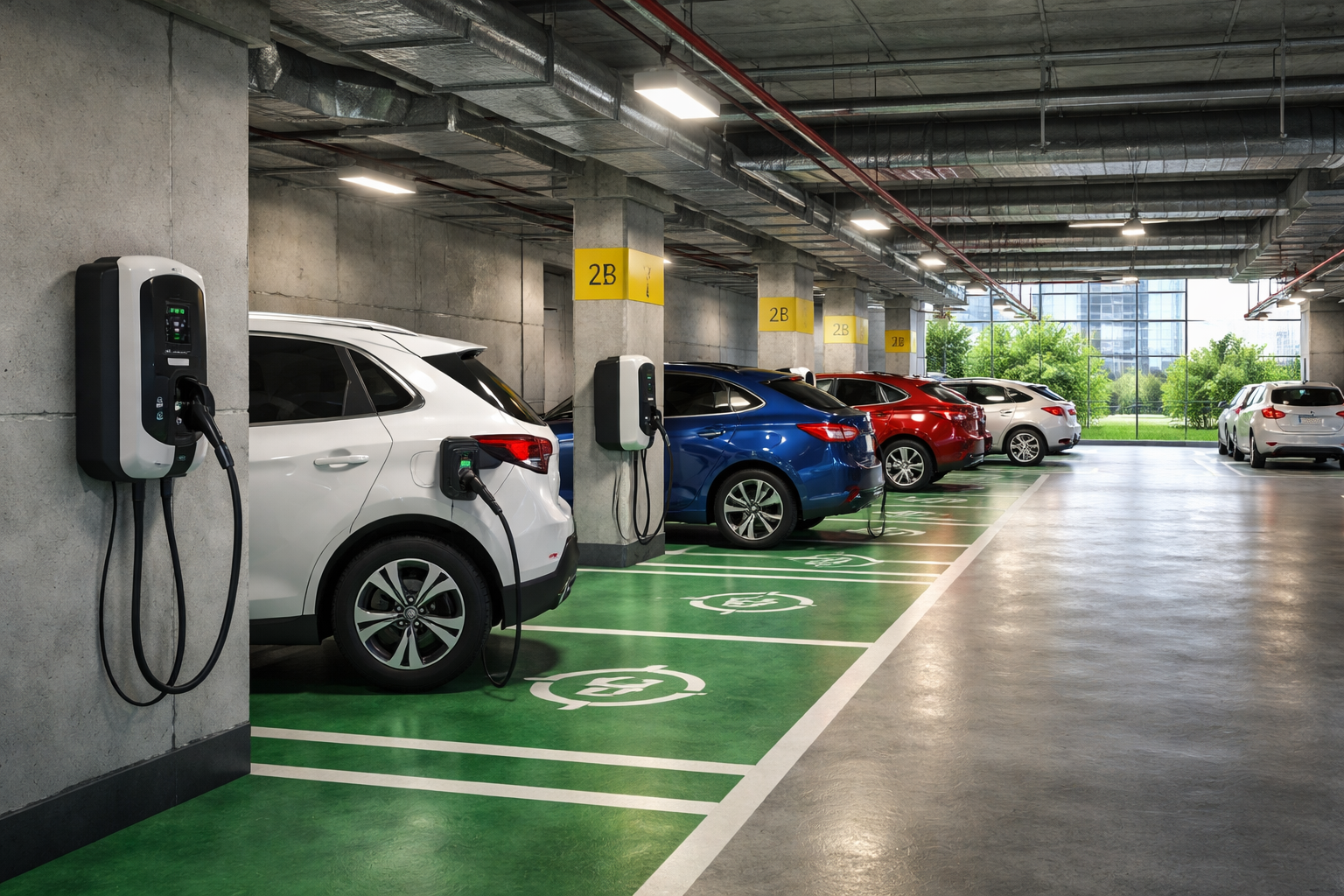
Introduction
Electric vehicles (EVs) are often marketed through high-power DC fast chargers, futuristic vehicles, and government subsidies. However, history shows that the real determinant of EV ecosystem success is not the vehicle or the DC charger—it is the humble AC charger.
AC charging infrastructure, especially at homes and workplaces, forms the foundation layer of EV adoption, influencing user experience, grid stability, and business viability. This article explores why AC chargers are critical, how they shape EV markets, and global success stories that prove their importance.
🌍 Why AC Chargers Matter More Than You Think
🔋 1. Most EV Charging Happens at Home and Work
Global data consistently shows that 80–90% of EV charging happens at home or workplace environments, not at public fast chargers.
This fundamental behavior pattern means:
- EV users treat charging like smartphone charging—overnight and passively
- Public DC charging is used mainly for long trips or emergencies
👉 Therefore, AC chargers define daily EV usability.
⚙️ 2. AC Chargers Enable Mass EV Adoption
AC charging solutions (3.3 kW, 7.4 kW, 11 kW, 22 kW) are:
- Affordable to install
- Easy to integrate into residential and commercial buildings
- Scalable without massive grid upgrades
From a system engineering perspective, AC chargers act as distributed energy endpoints, reducing peak load spikes compared to centralized DC fast chargers.
📊 Global Success Story: Norway – The Blueprint for EV Ecosystem Success
Norway is the world’s most successful EV market, with over 80% of new vehicle sales being electric and a rapidly growing EV stock.
Key Success Factors
✅ Strong Home Charging Infrastructure
Norway has a high share of single-family homes and reliable electricity supply, enabling widespread home charging. This created high user confidence and convenience, accelerating EV adoption.
✅ Extensive Charging Network
Norway also invested heavily in charging infrastructure, with one of the highest chargers-per-capita ratios globally, helping eliminate range anxiety.
✅ Policy + Infrastructure Alignment
Government incentives were combined with infrastructure development, creating a complete EV ecosystem rather than fragmented initiatives.
👉 Lesson: EV adoption scales when AC home charging is widely available.
🌐 Global Market Reality: Home Charging Dominates the Future
The International Energy Agency (IEA) estimates that home chargers will grow from ~27 million in 2023 to hundreds of millions by 2035, far outpacing public charging growth.
Even future projections show:
- ~⅔ of new chargers will be home chargers
- Public chargers will remain a minority but strategically important
👉 This confirms AC chargers are the primary infrastructure investment for mass EV adoption.
⚠️ When AC Charging Is Ignored: EV Market Failure Signals
🚫 Public Charging Concerns Still Block EV Purchases
Surveys show charging infrastructure remains one of the top barriers to EV adoption, even when vehicle costs decrease.
🚫 Infrastructure Gaps Slow Adoption
Regions with limited charging infrastructure report lower EV adoption rates due to range anxiety and usability concerns.
👉 Without AC infrastructure planning, the EV market cannot scale sustainably.
🧠 AC Chargers as the Core of EV Ecosystem
AC chargers are not just power devices—they are IoT and energy ecosystem nodes.
They enable:
- Smart grid integration
- Load balancing in apartments
- Time-of-use tariff optimization
- Solar + storage integration
- Vehicle-to-Grid (V2G) future models
This transforms AC chargers into distributed energy assets, not just consumer electronics.
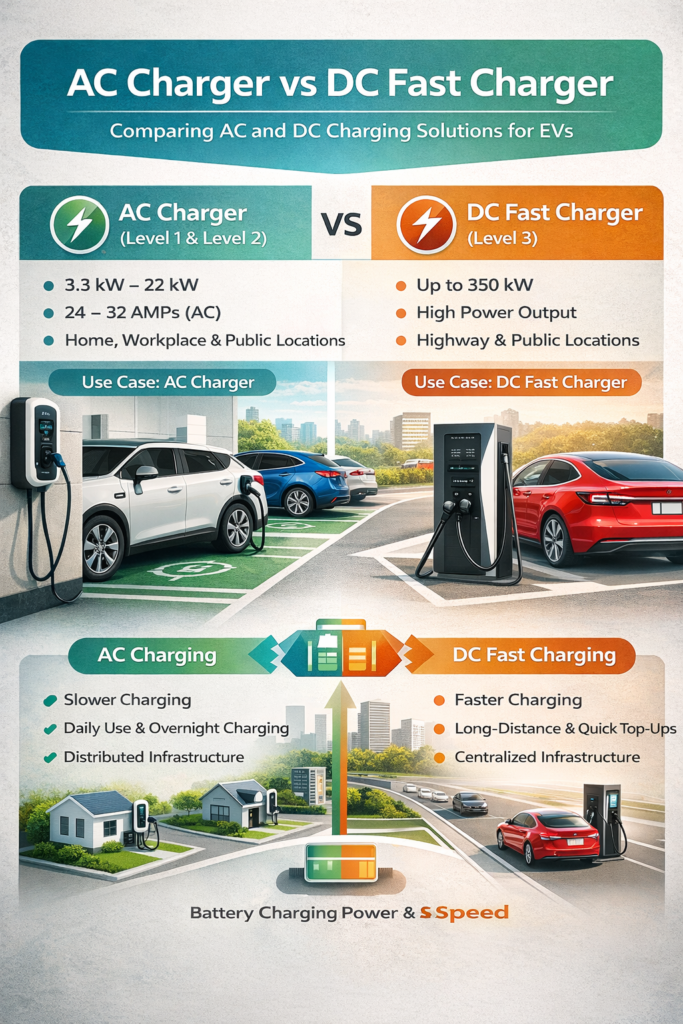
💰 Economic Perspective: AC vs DC Charging
| Parameter | AC Charging | DC Fast Charging |
|---|---|---|
| Installation Cost | Low | Very High |
| Grid Impact | Distributed | Centralized, heavy load |
| User Frequency | Daily | Occasional |
| ROI Model | Stable, volume-based | Risky, location-dependent |
| Ecosystem Role | Foundation | Acceleration |
👉 AC chargers build the market.
👉 DC chargers mature the market.
🚀 Strategic Insight for EV Industry Players
For OEMs, ODMs, utilities, and startups:
High-Impact AC Charging Opportunities
- Smart residential wallboxes
- Commercial 11 kW / 22 kW chargers
- Apartment load management gateways
- Cloud-connected billing platforms
- Firmware + OTA ecosystems
These platforms enable recurring revenue, ecosystem lock-in, and data monetization.
🎯 Conclusion: AC Chargers Decide EV Market Success
Electric vehicles are a system-of-systems: battery, silicon, software, grid, and user behavior. In this system, AC chargers are the root layer that determines success or failure.
AC chargers drive adoption.
DC chargers drive convenience.
But without AC chargers, the EV ecosystem collapses.
Countries that prioritized residential AC charging, like Norway, have achieved the world’s highest EV penetration. Markets that ignored foundational infrastructure continue to struggle with adoption.
For emerging markets like India, Southeast Asia, and Africa, the future of EV success will depend less on megawatt fast chargers and more on millions of intelligent AC chargers quietly charging vehicles every night.


Leave a Reply